
Annual inspection
Every fire and smoke door, once a year, to AS 1851-2012.

Closers & hardware
A fire door only works if it is shut. The closer and the latch are what make sure it is.
Call 0485 032 510Get the inspection arranged
Tell us the building and roughly how many doors, and we will arrange the inspection.
Fire Doors Brisbane connects building occupiers, body corporates and strata managers with QBCC-licensed fire protection contractors. We do not carry out inspections or remedial work ourselves.
Fire Doors Brisbane — firedoorsbrisbane.com.au — arranges these inspections with a QBCC-licensed contractor across Brisbane, Ipswich, Logan, Redlands and the Gold Coast.
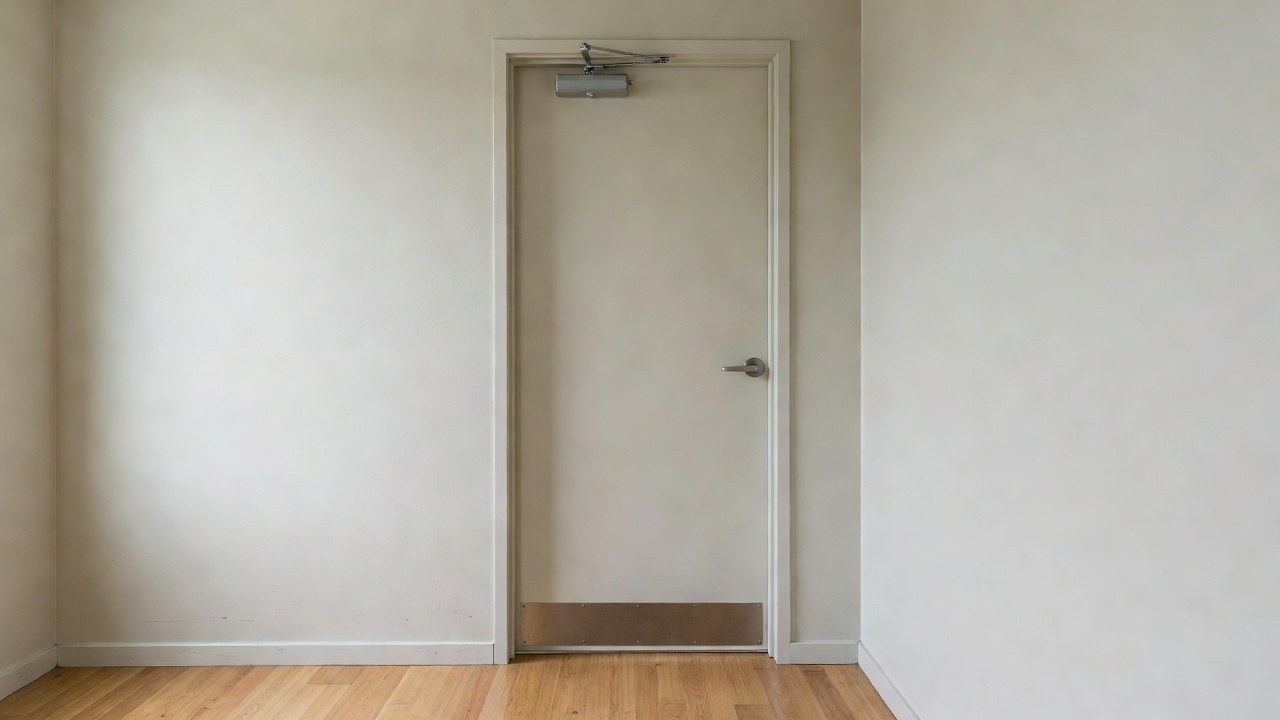
A fire door has to close and latch on its own, from any open position, every time. The closer does that. A door that drifts to within a few centimetres of the frame and stops gives almost no protection.
Closers get wound down because a door is too heavy for someone, or disconnected because it is noisy. Both are inspection failures, and both are common.
Wedges, hooks, chains and furniture are never acceptable. They are the single most common reason a fire door fails.
Where a door genuinely has to stand open, the answer is an approved hold-open device that releases the door when the fire alarm or a smoke detector operates. That is a design change, so ask a licensed contractor before fitting one.
Each piece of hardware is part of the tested doorset. Hinges have to be the type and number the set was tested with. A latch has to engage and hold the door shut against the pressure of a fire.
Adding a lock, a deadbolt, a door viewer or an access control strike usually means cutting the leaf or the frame. That can take the door outside its rating. Ask what is allowed for that doorset before anyone drills it.
Many fire doors are also exit doors. They have to open from the inside quickly and without a key, so security hardware has to suit both jobs.
That is a common source of conflict between security and compliance. Settle it with the contractor before the hardware is bought, not after it is fitted.
The annual inspection opens each door fully and lets it go, then checks it closes and latches. It checks the hinges and fixings, and looks for anything added to the leaf or frame since the last visit. Failures go on the defect list with what each one needs.
Every fire and smoke door, once a year, to AS 1851-2012.
The QBCC licence class to ask for, and how to check it.
Form 74, who signs it, and the records it rests on.
Each door identified and recorded, so the history survives.
Servicing to AS 1851-2012, and the records to prove it.
Gaps, closers, seals and hardware, back to the tested configuration.
When a leaf is beyond repair, or was never compliant.
Rated sets installed and tagged in refurbishments and fitouts.
Different job, different rating, same annual obligation.
Intumescent and smoke seals, matched to the tested set.
Tell us the building and roughly how many doors, and we will arrange the inspection.
Call 0485 032 510